PDG ibma
SSR - solid state relay AC Switch for microcontrollers , 3.3V~12V logic, AC 220V/5A (peak 10A)
SSR - solid state relay AC Switch for microcontrollers , 3.3V~12V logic, AC 220V/5A (peak 10A)
Impossible de charger la disponibilité du service de retrait
SPECIFICATIONS
Brand Name: RobotDyn
High-concerned chemical: None
Model Number: Mod-ThyristorACswitch-5A
Operating voltage: 3.3V/5V
Origin: Mainland China
Thyristor: BTA16-600B
Product Overview
If you need to control the AC power (lights, home equipment’s), a thyristor can help you with that. This is a very common module with very low on-resistance and a control voltage, which is compatible with any 3.3V or 5V micro-controller or mechanical switch. Thyristor allows you to control high-power devices with very low-power control mechanisms. This board has an optoisolator to protect your micro-controller from high AC currents. We also left more space, if you need to install the heat sink for thyristor.
Also we have2 channel.
Module 10A Specification
Module with heatsink can up amperage to 10A 400V and peak to 16A
VAC |
AC 400V/10A (peak 16A) |
Operating voltage |
3.3V/5V |
Signal level |
DC 1.2-24V 10mA |
Thyristor BTA16 |
600B |
Optoisolator |
MOC3042 |
PCB size |
22.00×46.00mm |
========================================
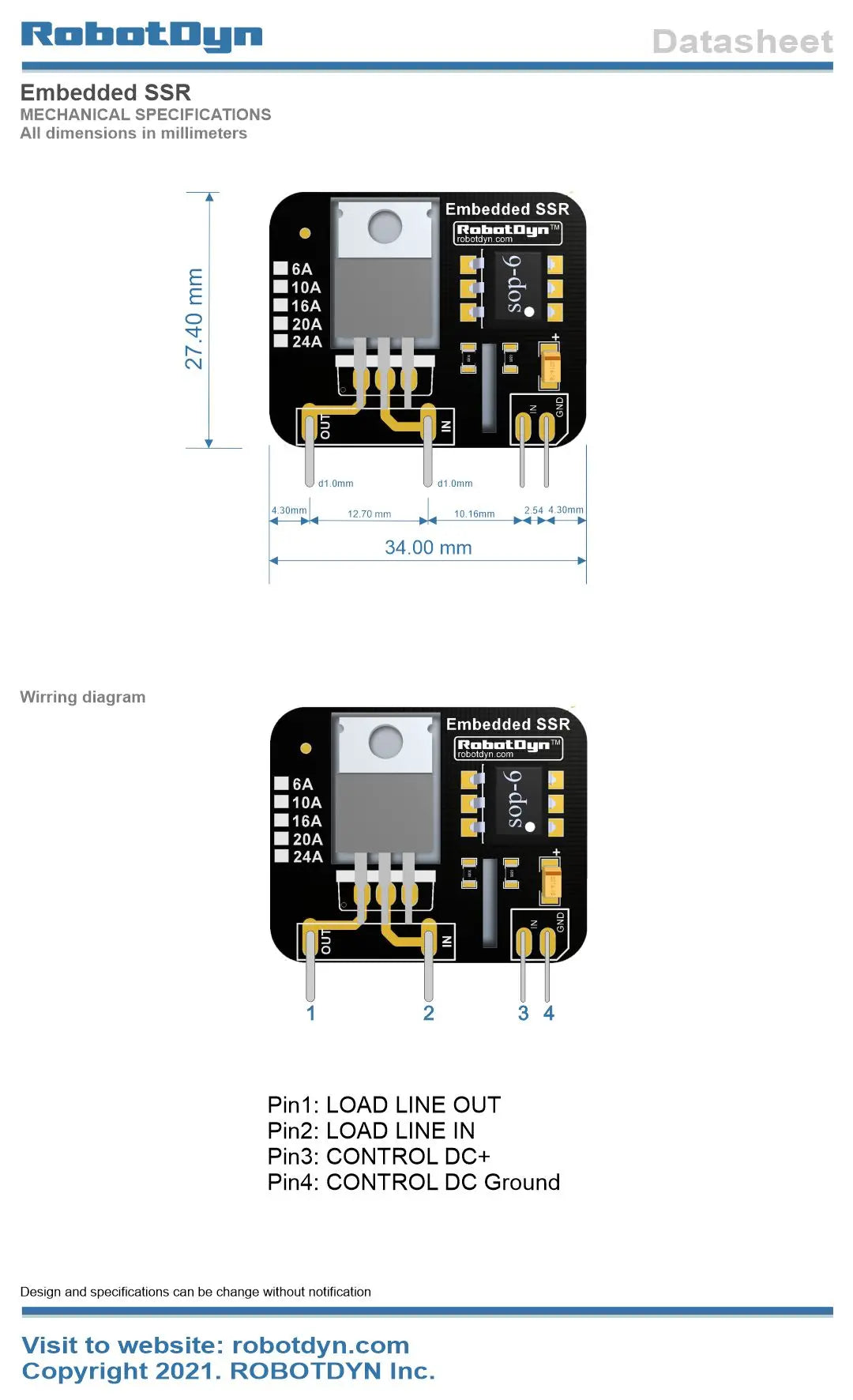
EMBED 16ASpecification
VAC |
AC 600V/16A |
Operating voltage |
3.3V/5V |
Signal level |
DC 3.3V/5V 10mA |
Thyristor BTA16 |
600B |
Optoisolator |
MOC3042 |
PCB size |
27x34mm |

SSR or Contact Relay?
These SSR’s inherently more reliable and capable of higher overloads before failure than contact relay. Heat is developed in a solid state relay due to the nominal voltage drop across the switching device.
Contact relays work in a simple way – when you energize the coil, the contacts engage. The contacts will open when you de-energize the coil. You will need a simple transistor to drive it. One thing that can happen is inductive kickback; if the switch in the circuit is initially closed and then immediately opened, there will be an instantaneous drop in current. To prevent this situation, you will need to add snubbing.
Another thing is that relay contacts are not invincible; if you open a contact under load, you can break it and it will not open up again. On the other hand, if a relay rated for power is used and you try to switch small signals, the contacts can eventually get dirty and won’t get a good connection between the contacts.
One of the biggest features of SSR is being silent, thanks to their solid-state. SSR can be used as PWM (Pulse Width Modulation) for regulation control valve actuators in radiator heating. Because there is no inductive coupling, SSR can be used in dangerous environments, particularly in explosive sensitive environments where sparking relay contacts are absolutely out.
SSR outputs have a much longer lifetime than relays. Because they’re built of semiconductors, they can last millions of cycles. To put this in perspective, let's imagine that you need to control a PWM actuator to control heating; it will work with a frequency of 1Hz (once per second). The relay can usually last 100,000 cycles, which will give around 1 day and 4 hours of work and constant clicking noise. SSR can last/work millions of cycles, and it is silent.
So: when you need a silent and frequently working output, you should choose SSR. It is best to use in hotel rooms or any place where you need to control light or heating, etc. silently.